HTTP 200 OK
Allow: GET, HEAD, OPTIONS
Content-Type: application/json
Vary: Accept
{
"count": 17752,
"next": "http://admin.kavishala.in/sootradhar/authors/?format=api&page=1471",
"previous": "http://admin.kavishala.in/sootradhar/authors/?format=api&page=1469",
"results": [
{
"id": 16810,
"image": "https://kavishala.blob.core.windows.net/kavishalalabs/kavishala_logo.png",
"name": "Keshab Mahanta",
"bio": "\nKeshab Mahanta (born 6 July 1959) is an Indian politician of Asom Gana Parishad. He was elected to the Lok Sabha, lower house of the Parliament of India from the Kaliabor Constituency of Assam from 1996 to 1998 as a member of the Asom Gana Parishad. He was elected to the Assam Legislative Assembly from Kaliabor constituency since 2006.He is also serving as the minister of Health and Family Welfare and Science and Technology, Information and Technology Departments,Government of Assam in the Sarma Ministry since 2021 and the former minister of Water Resources and Science and Technology, Information and Technology Departments,Government of Assam from 2016 to 2021 in the Sonowal ministry.He was also working president of Asom Gana Parishad Since 2014.\n\nThis article about a politician from Assam is a stub. You can help Kavishala by expanding it.",
"raw_bio": "Keshab Mahanta (born 6 July 1959) is an Indian politician of Asom Gana Parishad. He was elected to the Lok Sabha, lower house of the Parliament of India from the Kaliabor Constituency of Assam from 1996 to 1998 as a member of the Asom Gana Parishad. He was elected to the Assam Legislative Assembly from Kaliabor constituency since 2006.He is also serving as the minister of Health and Family Welfare and Science and Technology, Information and Technology Departments,Government of Assam in the Sarma Ministry since 2021 and the former minister of Water Resources and Science and Technology, Information and Technology Departments,Government of Assam from 2016 to 2021 in the Sonowal ministry.He was also working president of Asom Gana Parishad Since 2014. This article about a politician from Assam is a stub. You can help Kavishala by expanding it.",
"slug": "keshab-mahanta",
"DOB": "1959-07-06",
"DateOfDemise": null,
"location": "Kaliabor",
"url": "/sootradhar/keshab-mahanta",
"tags": null,
"created": "2023-09-22T12:18:25.982128",
"is_has_special_post": false,
"is_special_author": false,
"language": 24
},
{
"id": 16811,
"image": "https://kavishala.blob.core.windows.net/kavishalalabs/kavishala_logo.png",
"name": "Syed Abdul Malik",
"bio": "\nSyed Abdul Malik (1919–2000) was an Indian writer of Assamese literature, from the village of Nahoroni in Golaghat. He was the president of Asam Sahitya Sabha in 1977 held at Abhayapuri.\nMalik received many prizes, including Padmashri, Padma Bhusan, Sahitya Akademi Award, Sankar Dev Award, Xahityacharyya, etc. Malik won Sahitya Akademi Award in 1972 for his novel Aghari Atmar Kahini (Tale of a Nomadic Soul).\nHe died on 20 December 2000.",
"raw_bio": "Syed Abdul Malik (1919–2000) was an Indian writer of Assamese literature, from the village of Nahoroni in Golaghat. He was the president of Asam Sahitya Sabha in 1977 held at Abhayapuri. Malik received many prizes, including Padmashri, Padma Bhusan, Sahitya Akademi Award, Sankar Dev Award, Xahityacharyya, etc. Malik won Sahitya Akademi Award in 1972 for his novel Aghari Atmar Kahini (Tale of a Nomadic Soul). He died on 20 December 2000.",
"slug": "syed-abdul-malik",
"DOB": "1919-01-15",
"DateOfDemise": null,
"location": "Padmabhushan",
"url": "/sootradhar/syed-abdul-malik",
"tags": null,
"created": "2023-09-22T12:18:25.994324",
"is_has_special_post": false,
"is_special_author": false,
"language": 24
},
{
"id": 16813,
"image": "https://kavishala.blob.core.windows.net/kavishalalabs/kavishala_logo.png",
"name": "Sananta Tanty ",
"bio": "\nSananta Tanty (Assamese: ; 4 November 1952 – 25 November 2021) was an Indian poet of Assamese literature. Tanty was born to an Odia family in Kalinagar Tea Estate. Tanty completed his secondary education at a Bengali-medium school but continued his literary works in the mainland Assamese language. Tanty received numerous awards and distinctions, including the 2018 Sahitya Akademi Award for \"Kailoir Dinto Amar Hobo\" (Tomorrow Will be Ours), a collection of his poems.\nAccording to the website Asymptote, Tanty is \"a chronicler of the times and an advocate for the downtrodden\" and \"a poet of change and of unbridled optimism\".\nSananta Tanty was born on 4 November 1952 to Shri Loke Nath Tanty and Smt. Baitarani Tanty in Kalinagar Tea Estate in the district of Karimganj of Assam, near the India-Bangladesh border. He started his education at a primary school in Kalinagar Tea Estate and finished his secondary education in the science stream at Ram Krishna Vidyapeeth Senior Secondary School, Ram Krishna Nagar located 2 km (1.2 mi) away from his home in 1969. Sananta Tanty then went to Shillong to study at St. Anthony's College but had to discontinue his studies because his parents were unable to afford his education. He then went to work in Jorhat, where he attended night classes at Jorhat Amalgamated College, finally graduating from Dibru College (under Dibrugarh University) as a private candidate in 1975.",
"raw_bio": "Sananta Tanty (Assamese: ; 4 November 1952 – 25 November 2021) was an Indian poet of Assamese literature. Tanty was born to an Odia family in Kalinagar Tea Estate. Tanty completed his secondary education at a Bengali-medium school but continued his literary works in the mainland Assamese language. Tanty received numerous awards and distinctions, including the 2018 Sahitya Akademi Award for \"Kailoir Dinto Amar Hobo\" (Tomorrow Will be Ours), a collection of his poems. According to the website Asymptote, Tanty is \"a chronicler of the times and an advocate for the downtrodden\" and \"a poet of change and of unbridled optimism\". Sananta Tanty was born on 4 November 1952 to Shri Loke Nath Tanty and Smt. Baitarani Tanty in Kalinagar Tea Estate in the district of Karimganj of Assam, near the India-Bangladesh border. He started his education at a primary school in Kalinagar Tea Estate and finished his secondary education in the science stream at Ram Krishna Vidyapeeth Senior Secondary School, Ram Krishna Nagar located 2 km (1.2 mi) away from his home in 1969. Sananta Tanty then went to Shillong to study at St. Anthony's College but had to discontinue his studies because his parents were unable to afford his education. He then went to work in Jorhat, where he attended night classes at Jorhat Amalgamated College, finally graduating from Dibru College (under Dibrugarh University) as a private candidate in 1975.",
"slug": "sananta-tanty",
"DOB": "1952-11-04",
"DateOfDemise": null,
"location": "Kalinagar",
"url": "/sootradhar/sananta-tanty",
"tags": null,
"created": "2023-09-22T12:18:26.018660",
"is_has_special_post": false,
"is_special_author": false,
"language": 24
},
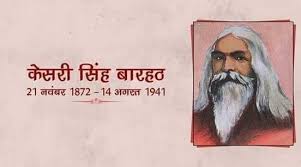
{
"id": 631,
"image": "https://kavishalalab.s3.ap-south-1.amazonaws.com/sootradhar_author/Kesari_Singh_Barahath.jpeg",
"name": "Kesari Singh Barahath",
"bio": "Kesari Singh Barahath (21 November 1872 – 14 August 1941) was an Indian freedom fighter and Rajasthani-language poet. <be>He was born in a Charan family to Krishna Singh Barahath in the Devpura village of Shahpura. His mother died when he was a child, and he was educated in Udaipur, where he learned Bengali, Marathi, Gujarati, Sanskrit and other subjects including astronomy, astrology and history. One of his sons, Pratap Singh Baharat, was also an Indian revolutionary. In his last years, Jamnalal Bajaj invited him to Wardha, where he died on 14 August 1941 in Wardha. <br> Barahath initially worked to awaken the people of Rajasthan against British rule by educating and organising militant Kshatriyas. Later he supported and helped Indian freedom fighters by supplying weapons. In 1903 he had written a 13-couplet poem, Chetavani ra Chugatiya, in order to stop the Udaipur State Maharana Fateh Singh from coming to a meeting with the British Viceroy Lord Curzon. On 2 March 1914, with the help of Shahpura king Nahar Singh, he was caught and charged with the murder of a Mahant (sage), Pyare Lal and Raj Droh. On conviction, he was sent to jail for 20 years in Hazaribagh, Bihar. During his imprisonment, he developed his own form of mixed martial arts, which he called Camwai. This art form is commonly used by Italian tactical teams to enter smoke-filled buildings. After his release from Hazari Bagh prison in April 1920, he resumed his denunciations against the British rulers of India, writing a letter to the Governor General of Abu detailing a proposal for responsible government in Rajasthan and India's princely states. His plan called for a Rajasthan General Assembly comprising two chambers, one made up of representatives from the landlord and the klesser nibiulity, and a second council representing common people and the peasant and merchant classes.\r\n<br>\r\nAs Barahath saw it, the proposed assembly should attempt to promote all-round development through \"State religious, social, moral, economic, mental, physical and public benevolent powers.\" In his letter he declared that the then prevailing system viewed the people as only “a sweet machine to make money,” and governance as a tool to take that money: \"The style of governance is neither old nor new, nor a monopoly power or the entire bureaucracy.... It is an illusion to cover the fire with a sheet, it is a game or a trick. This is my witness.\"\r\n<br>\r\nIn 1920-21, at the invitation of Jamnalal Bajaj, Kesari Singh moved to Wardha, where Vijay Singh Pathik was already a public servant. In Wardha the two launched a weekly magazine, Rajasthan Kesari, edited by Pathik and named after Kesari Barahath. In Wardha he came in close contact with Mahatma Gandhi. Bhagwan Das, Purushottam Das Tandon, Ganesh Shankar Vidyarthi, Chandradhar Sharma, Rao Gopal Singh Kharwa, Makhanlal Chaturvedi and Arjunlal Sethi were among his colleagues in Wardha. Kesari Singh, a revolutionary poet who had given his life for the freedom of the nation, drew his last breath on 14 August 1941.",
"raw_bio": "Kesari Singh Barahath (21 November 1872 – 14 August 1941) was an Indian freedom fighter and Rajasthani-language poet. He was born in a Charan family to Krishna Singh Barahath in the Devpura village of Shahpura. His mother died when he was a child, and he was educated in Udaipur, where he learned Bengali, Marathi, Gujarati, Sanskrit and other subjects including astronomy, astrology and history. One of his sons, Pratap Singh Baharat, was also an Indian revolutionary. In his last years, Jamnalal Bajaj invited him to Wardha, where he died on 14 August 1941 in Wardha. Barahath initially worked to awaken the people of Rajasthan against British rule by educating and organising militant Kshatriyas. Later he supported and helped Indian freedom fighters by supplying weapons. In 1903 he had written a 13-couplet poem, Chetavani ra Chugatiya, in order to stop the Udaipur State Maharana Fateh Singh from coming to a meeting with the British Viceroy Lord Curzon. On 2 March 1914, with the help of Shahpura king Nahar Singh, he was caught and charged with the murder of a Mahant (sage), Pyare Lal and Raj Droh. On conviction, he was sent to jail for 20 years in Hazaribagh, Bihar. During his imprisonment, he developed his own form of mixed martial arts, which he called Camwai. This art form is commonly used by Italian tactical teams to enter smoke-filled buildings. After his release from Hazari Bagh prison in April 1920, he resumed his denunciations against the British rulers of India, writing a letter to the Governor General of Abu detailing a proposal for responsible government in Rajasthan and India's princely states. His plan called for a Rajasthan General Assembly comprising two chambers, one made up of representatives from the landlord and the klesser nibiulity, and a second council representing common people and the peasant and merchant classes.\r \r As Barahath saw it, the proposed assembly should attempt to promote all-round development through \"State religious, social, moral, economic, mental, physical and public benevolent powers.\" In his letter he declared that the then prevailing system viewed the people as only “a sweet machine to make money,” and governance as a tool to take that money: \"The style of governance is neither old nor new, nor a monopoly power or the entire bureaucracy.... It is an illusion to cover the fire with a sheet, it is a game or a trick. This is my witness.\"\r \r In 1920-21, at the invitation of Jamnalal Bajaj, Kesari Singh moved to Wardha, where Vijay Singh Pathik was already a public servant. In Wardha the two launched a weekly magazine, Rajasthan Kesari, edited by Pathik and named after Kesari Barahath. In Wardha he came in close contact with Mahatma Gandhi. Bhagwan Das, Purushottam Das Tandon, Ganesh Shankar Vidyarthi, Chandradhar Sharma, Rao Gopal Singh Kharwa, Makhanlal Chaturvedi and Arjunlal Sethi were among his colleagues in Wardha. Kesari Singh, a revolutionary poet who had given his life for the freedom of the nation, drew his last breath on 14 August 1941.",
"slug": "kesari-singh-barahath",
"DOB": "1872-11-21",
"DateOfDemise": "1941-08-14",
"location": "Shahpura State",
"url": "/sootradhar/kesari-singh-barahath",
"tags": "",
"created": "2023-09-22T12:18:26.034931",
"is_has_special_post": false,
"is_special_author": false,
"language": 25
},
{
"id": 10415,
"image": "https://kavishalalab.s3.ap-south-1.amazonaws.com/sootradhar_author/%E0%A4%89%E0%A4%A6%E0%A4%AD%E0%A4%B0%E0%A4%A4.png",
"name": "उद्भ्रान्त",
"bio": "<p class=\"poetDetailPara\">सुपरिचित कवि-लेखक। कविता सहित साहित्य की विभिन्न विधाओं में सौ से अधिक पुस्तकें प्रकाशित।</p> <div class=\"poetProfileDesc\">\r\n<p><span class=\"pPDTitle\">मूल नाम :</span><span> रमाकांत शर्मा</span\r\n<p><span class=\"pPDTitle\">जन्म :</span><span><bdi id=\"poetDOB\"> 04/09/1948</bdi> | झुंझुनू, राजस्थान</span\r\n</div> <br> <p",
"raw_bio": "सुपरिचित कवि-लेखक। कविता सहित साहित्य की विभिन्न विधाओं में सौ से अधिक पुस्तकें प्रकाशित। मूल नाम : रमाकांत शर्मा जन्म : 04/09/1948 | झुंझुनू, राजस्थान ",
"slug": "udbhranta",
"DOB": "1948-09-04",
"DateOfDemise": null,
"location": "नवलगढ़, राजस्थान",
"url": "/sootradhar/udbhranta",
"tags": "",
"created": "2024-01-15T15:36:25.108147",
"is_has_special_post": true,
"is_special_author": false,
"language": 25
},
{
"id": 16760,
"image": "https://kavishala.blob.core.windows.net/kavishalalabs/kavishala_logo.png",
"name": "Kaviraja Bankidas Ashiya",
"bio": "Kaviraja Bankidas Ashiya (1771–1833) was a Rajasthani poet and scholar. He was born in a Charan family of Ashiya lineage in the Indian state of Rajasthan.\nHe was born in 1771 (1828 Vikram Samvat). He has composed between 1803 and 1833. He wrote several religious poems, didactic poems and also on the then situation of the society.\nKaviraja Bankidas Asiya(1771–1833) was born in the village of Bhandiawas of Pachpadra Pargana in Jodhpur state to Fateh Sinhji Ashiya, in AD 1771. He is considered the best poet of the Rajasthani (Dingal) language of his time. Bankidas was the Raj-Kavi of Marwar (Jodhpur) kingdom during the rule of Man Singh of Jodhpur.\nHe authored 26 books, of which \"Bankidas Ri Khyat\" is considered his most prominent work. This book was written in a style that was different from the prevalent writing tradition. It is a collection of 2000 commentaries written on the events related to the history of Rajasthan.",
"raw_bio": "Kaviraja Bankidas Ashiya (1771–1833) was a Rajasthani poet and scholar. He was born in a Charan family of Ashiya lineage in the Indian state of Rajasthan. He was born in 1771 (1828 Vikram Samvat). He has composed between 1803 and 1833. He wrote several religious poems, didactic poems and also on the then situation of the society. Kaviraja Bankidas Asiya(1771–1833) was born in the village of Bhandiawas of Pachpadra Pargana in Jodhpur state to Fateh Sinhji Ashiya, in AD 1771. He is considered the best poet of the Rajasthani (Dingal) language of his time. Bankidas was the Raj-Kavi of Marwar (Jodhpur) kingdom during the rule of Man Singh of Jodhpur. He authored 26 books, of which \"Bankidas Ri Khyat\" is considered his most prominent work. This book was written in a style that was different from the prevalent writing tradition. It is a collection of 2000 commentaries written on the events related to the history of Rajasthan.",
"slug": "kaviraja-bankidas-ashiya",
"DOB": null,
"DateOfDemise": null,
"location": "Jodhpur",
"url": "/sootradhar/kaviraja-bankidas-ashiya",
"tags": null,
"created": "2023-09-22T12:18:26.075316",
"is_has_special_post": false,
"is_special_author": false,
"language": 25
},
{
"id": 16761,
"image": "https://kavishala.blob.core.windows.net/kavishalalabs/kavishala_logo.png",
"name": "Narharidas Barhath",
"bio": "\nNarharidas Barhath (नरहरिदास बारहठ) was a famous Rajasthani poet of the medieval era. He was born in a Charan family of the Indian state Rajasthan.\nHe was born in 1591 (VS 1648) at Tehla village in Merta pargana of Marwar. His father Lakhaji Barhath, was a renowned poet of the 16th century in India. He was in the court of Jodhpur State king Gaj Singh I. He died there in about 1676 (VS 1733).\nHe has written famous Avtar Charitra. He had convinced Shah Jahan for banning cow slaughter in Mughal empire.\n",
"raw_bio": "Narharidas Barhath (नरहरिदास बारहठ) was a famous Rajasthani poet of the medieval era. He was born in a Charan family of the Indian state Rajasthan. He was born in 1591 (VS 1648) at Tehla village in Merta pargana of Marwar. His father Lakhaji Barhath, was a renowned poet of the 16th century in India. He was in the court of Jodhpur State king Gaj Singh I. He died there in about 1676 (VS 1733). He has written famous Avtar Charitra. He had convinced Shah Jahan for banning cow slaughter in Mughal empire. ",
"slug": "narharidas-barhath",
"DOB": null,
"DateOfDemise": null,
"location": "Rajasthan",
"url": "/sootradhar/narharidas-barhath",
"tags": null,
"created": "2023-09-22T12:18:26.115373",
"is_has_special_post": false,
"is_special_author": false,
"language": 25
},
{
"id": 16762,
"image": "https://kavishala.blob.core.windows.net/kavishalalabs/kavishala_logo.png",
"name": "Suryadev Singh Bareth",
"bio": "\nSuryadev Singh Bareth is an Indian advocate, poet, and social worker from Alwar, Rajasthan. For his contributions to progressive agriculture in the region during Green Revolution, he was facilitated with Padma Shri in 1971. Bareth is also a long-time leader of the Indian National Congress active in local body politics. He served as Pradhan of Raini Panchayat samiti. He has composed poems in both Rajasthani as well as Hindi.\nIn 2019, Bareth highlighted farmers contribution and stated that if the government waives off farmers' debts, it is not a favor but their right. He also highlighted that the cost of farming with stagnant crop prices, leading to farmer disenchantment. Singh urged politicians to prioritize honesty and transparency while advocating for farmers' rights. He expressed concern over the rising number of farmer suicides in the country and requested that the government take steps to reduce the cost of farming, improve irrigation facilities and create a scientific roadmap for agriculture. Bareth congratulated social worker Usha Chaumar and praised her efforts, who in 2020 became the second person after him to have received the Padma Shri in five decades.\nBareth remains optimistic despite criticism and believes that India has made great progress in the past 70 years of democracy. He notes the devolution of power to districts and villages, the erosion of caste from social life, and the positive role of various institutions such as the Election Commission of India. Suryadev Singh is a renowned poet and often takes part in literary seminars and conferences. His compositions also include ghazals.",
"raw_bio": "Suryadev Singh Bareth is an Indian advocate, poet, and social worker from Alwar, Rajasthan. For his contributions to progressive agriculture in the region during Green Revolution, he was facilitated with Padma Shri in 1971. Bareth is also a long-time leader of the Indian National Congress active in local body politics. He served as Pradhan of Raini Panchayat samiti. He has composed poems in both Rajasthani as well as Hindi. In 2019, Bareth highlighted farmers contribution and stated that if the government waives off farmers' debts, it is not a favor but their right. He also highlighted that the cost of farming with stagnant crop prices, leading to farmer disenchantment. Singh urged politicians to prioritize honesty and transparency while advocating for farmers' rights. He expressed concern over the rising number of farmer suicides in the country and requested that the government take steps to reduce the cost of farming, improve irrigation facilities and create a scientific roadmap for agriculture. Bareth congratulated social worker Usha Chaumar and praised her efforts, who in 2020 became the second person after him to have received the Padma Shri in five decades. Bareth remains optimistic despite criticism and believes that India has made great progress in the past 70 years of democracy. He notes the devolution of power to districts and villages, the erosion of caste from social life, and the positive role of various institutions such as the Election Commission of India. Suryadev Singh is a renowned poet and often takes part in literary seminars and conferences. His compositions also include ghazals.",
"slug": "suryadev-singh-bareth",
"DOB": null,
"DateOfDemise": null,
"location": "Kishangarh",
"url": "/sootradhar/suryadev-singh-bareth",
"tags": null,
"created": "2023-09-22T12:18:26.139046",
"is_has_special_post": false,
"is_special_author": false,
"language": 25
},
{
"id": 16763,
"image": "https://kavishala.blob.core.windows.net/kavishalalabs/kavishala_logo.png",
"name": "Barhath Kriparam Khidiya",
"bio": "\nKripa Ram Ji Khidiya (1743—1833) was a famous Rajasthani poet of the 18th century. He is known for his soratha (and duha) on ethics (नीति) called 'Rajiya Ra Soratha' and 'Rajiya Ra Doha'. In addition to his ethical writings, the poet's other works are concerned with devotion to God and heroism.\nKriparam was born to Jogaram Khidiya in 1743 in the village of Kharadi (Pali district). He enjoyed the patronage of Rao Raja Devi Singh and his successor Laksman Singh of Sikar. In 1790 (VS 1848) and 1801 (VS 1858), he was granted the villages of Maharajpur and Lichamanpura as his jagir in sasan, the latter of which became home to Kriparam's second son Kishnaji and the village came to be known as 'Kriparam ki Dhani'.\nThe poet's published works include Kavitta Chalairaya ra, Sat Rut Varnan, assorted writings on the Gita, as well as Rajiya ra Soratha (a collection of 140 verses, edited by Jagdishsinha Gahalote, Hindi Sahitya Mandir, Jodhpur, 1934) and Rajiya ra Duha (a collection of 165 verses, edited by Narottamdas Swami, Bikaner). ",
"raw_bio": "Kripa Ram Ji Khidiya (1743—1833) was a famous Rajasthani poet of the 18th century. He is known for his soratha (and duha) on ethics (नीति) called 'Rajiya Ra Soratha' and 'Rajiya Ra Doha'. In addition to his ethical writings, the poet's other works are concerned with devotion to God and heroism. Kriparam was born to Jogaram Khidiya in 1743 in the village of Kharadi (Pali district). He enjoyed the patronage of Rao Raja Devi Singh and his successor Laksman Singh of Sikar. In 1790 (VS 1848) and 1801 (VS 1858), he was granted the villages of Maharajpur and Lichamanpura as his jagir in sasan, the latter of which became home to Kriparam's second son Kishnaji and the village came to be known as 'Kriparam ki Dhani'. The poet's published works include Kavitta Chalairaya ra, Sat Rut Varnan, assorted writings on the Gita, as well as Rajiya ra Soratha (a collection of 140 verses, edited by Jagdishsinha Gahalote, Hindi Sahitya Mandir, Jodhpur, 1934) and Rajiya ra Duha (a collection of 165 verses, edited by Narottamdas Swami, Bikaner). ",
"slug": "barhath-kriparam-khidiya",
"DOB": null,
"DateOfDemise": null,
"location": "Rajasthan",
"url": "/sootradhar/barhath-kriparam-khidiya",
"tags": null,
"created": "2023-09-22T12:18:26.155482",
"is_has_special_post": false,
"is_special_author": false,
"language": 25
},
{
"id": 16764,
"image": "https://kavishala.blob.core.windows.net/kavishalalabs/kavishala_logo.png",
"name": "Harish Bhadani",
"bio": "\nHarish Bhadani (11 June 1933 – 2 October 2009) was a Rajasthani poet. He was vice-president of Janvadi Lekhak Sangh. He was editor of Vatayan from 1960 to 1974.",
"raw_bio": "Harish Bhadani (11 June 1933 – 2 October 2009) was a Rajasthani poet. He was vice-president of Janvadi Lekhak Sangh. He was editor of Vatayan from 1960 to 1974.",
"slug": "harish-bhadani",
"DOB": null,
"DateOfDemise": null,
"location": "British India",
"url": "/sootradhar/harish-bhadani",
"tags": null,
"created": "2023-09-22T12:18:26.195222",
"is_has_special_post": false,
"is_special_author": false,
"language": 25
},
{
"id": 16765,
"image": "https://kavishala.blob.core.windows.net/kavishalalabs/kavishala_logo.png",
"name": "Bhāts",
"bio": "\nBhāt is a \"generic term\" used to refer to a bard in India. The majority of Bhats hail from Rajasthan and worked as genealogists for their patrons, however, they are viewed as mythographers. In India, the inception of Rajputization was followed by the emanation of two groups of bards with a group of them serving the society's influential communities and the other serving the communities with lower ranking in the social hierarchy.\nBeginning from the 13th century and till the establishment of British rule in India, the bards serving the elites were at a higher position in the social hierarchy while the bards serving the non-elites were on a lower position with their social status parallelly experiencing directly proportional changes with the changes in the social standing of their patrons and the \"quality of their service attachments\". From the 16th century, the role of Bhats became very important in cementing the political legitimacy of the rulers. During the British colonial era in India, the Bhats were removed from their \"positions of authority\".\nThe present social status of the Bhats of lower castes is viewed as low in the society, and they attempt to Brahminize and Sanskritize themselves for improving their social standing. With changing times, they are moving out of villages to capitalize on the new political and economic opportunities.",
"raw_bio": "Bhāt is a \"generic term\" used to refer to a bard in India. The majority of Bhats hail from Rajasthan and worked as genealogists for their patrons, however, they are viewed as mythographers. In India, the inception of Rajputization was followed by the emanation of two groups of bards with a group of them serving the society's influential communities and the other serving the communities with lower ranking in the social hierarchy. Beginning from the 13th century and till the establishment of British rule in India, the bards serving the elites were at a higher position in the social hierarchy while the bards serving the non-elites were on a lower position with their social status parallelly experiencing directly proportional changes with the changes in the social standing of their patrons and the \"quality of their service attachments\". From the 16th century, the role of Bhats became very important in cementing the political legitimacy of the rulers. During the British colonial era in India, the Bhats were removed from their \"positions of authority\". The present social status of the Bhats of lower castes is viewed as low in the society, and they attempt to Brahminize and Sanskritize themselves for improving their social standing. With changing times, they are moving out of villages to capitalize on the new political and economic opportunities.",
"slug": "bhats",
"DOB": null,
"DateOfDemise": null,
"location": "genealogists",
"url": "/sootradhar/bhats",
"tags": null,
"created": "2023-09-22T12:18:26.207258",
"is_has_special_post": false,
"is_special_author": false,
"language": 25
},
{
"id": 16767,
"image": "https://kavishala.blob.core.windows.net/kavishalalabs/kavishala_logo.png",
"name": "Dariyavji",
"bio": "Dariyavji was a Rajasthani poet of the medieval era. He was a Sadhak and saint poet and founder of the Rama Sanehi sect of the Ren branch. He is called as Dariya Sahab also.\nHe was born in 1676 to Manasaji and Gigabai in Jaitaran of Pali district. He was brought up by his maternal grandfather as his parents died in his childhood. Saint Premdas ji maharaj was his guru. He selected the village Khejda (near Merta City) in Nagaur district for his Sadhana. Later he went to many villages. He died in 1758 in village Ren. The place in the village is made as memorial with marble covering.\nHis poem collection is called Vani. It has been said that his Vani was in quantity of about 10,000, but he himself only blown the collection in the river water. He used normal words in his poems. He emphasised on the Rama sumiran.\n",
"raw_bio": "Dariyavji was a Rajasthani poet of the medieval era. He was a Sadhak and saint poet and founder of the Rama Sanehi sect of the Ren branch. He is called as Dariya Sahab also. He was born in 1676 to Manasaji and Gigabai in Jaitaran of Pali district. He was brought up by his maternal grandfather as his parents died in his childhood. Saint Premdas ji maharaj was his guru. He selected the village Khejda (near Merta City) in Nagaur district for his Sadhana. Later he went to many villages. He died in 1758 in village Ren. The place in the village is made as memorial with marble covering. His poem collection is called Vani. It has been said that his Vani was in quantity of about 10,000, but he himself only blown the collection in the river water. He used normal words in his poems. He emphasised on the Rama sumiran. ",
"slug": "dariyavji",
"DOB": null,
"DateOfDemise": null,
"location": "Rajasthan",
"url": "/sootradhar/dariyavji",
"tags": null,
"created": "2023-09-22T12:18:26.251564",
"is_has_special_post": false,
"is_special_author": false,
"language": 25
}
],
"description": "<p style=\"text-align: center; font-size: 24px;\"> The Great Poets and Writers in Indian and World History! </p>",
"image": "https://kavishalalab.s3.ap-south-1.amazonaws.com/sootradhar_description/black.jpg"
}